
Testing Your Material in Our Full-Scale Pilot Facility: Why We Do it & What to Expect

Designing a reliable pneumatic conveying system isn’t just about selecting equipment; it’s about understanding how your specific material behaves in motion. At Dynamic Air, testing is a critical step in our engineering process. That’s why we maintain a dedicated pneumatic conveying testing facility designed for evaluating materials, validating system designs, and reducing uncertainty long before the installation of a new system.
Why Testing Matters
All bulk materials are not created equal.
Materials bearing the same chemical name can have drastically different handling characteristics due to different material properties. For example, “limestone” can have dramatically different handling characteristics due to differences in particle size, particle size distribution, particle shape, surface roughness, moisture content, bulk density, and so on. And to add to that, the design objective can produce different results. For example, a higher velocity system will have different efficiencies than a slower velocity system. Without testing, it’s like shooting in the dark to hit the desired design targets.
By conducting material testing for pneumatic conveying, Dynamic Air helps customers:
- Identify the most effective conveying method
- Provide assurances that the design objectives will be met
- Reduce startup and commissioning risks
- Improve long-term system reliability
- Optimize air usage and conveying velocities
Testing gives our engineers the insight needed to design systems that perform as expected. Not just in theory, but in real-world operations.
Inside Dynamic Air’s Pneumatic Conveying Test Facility
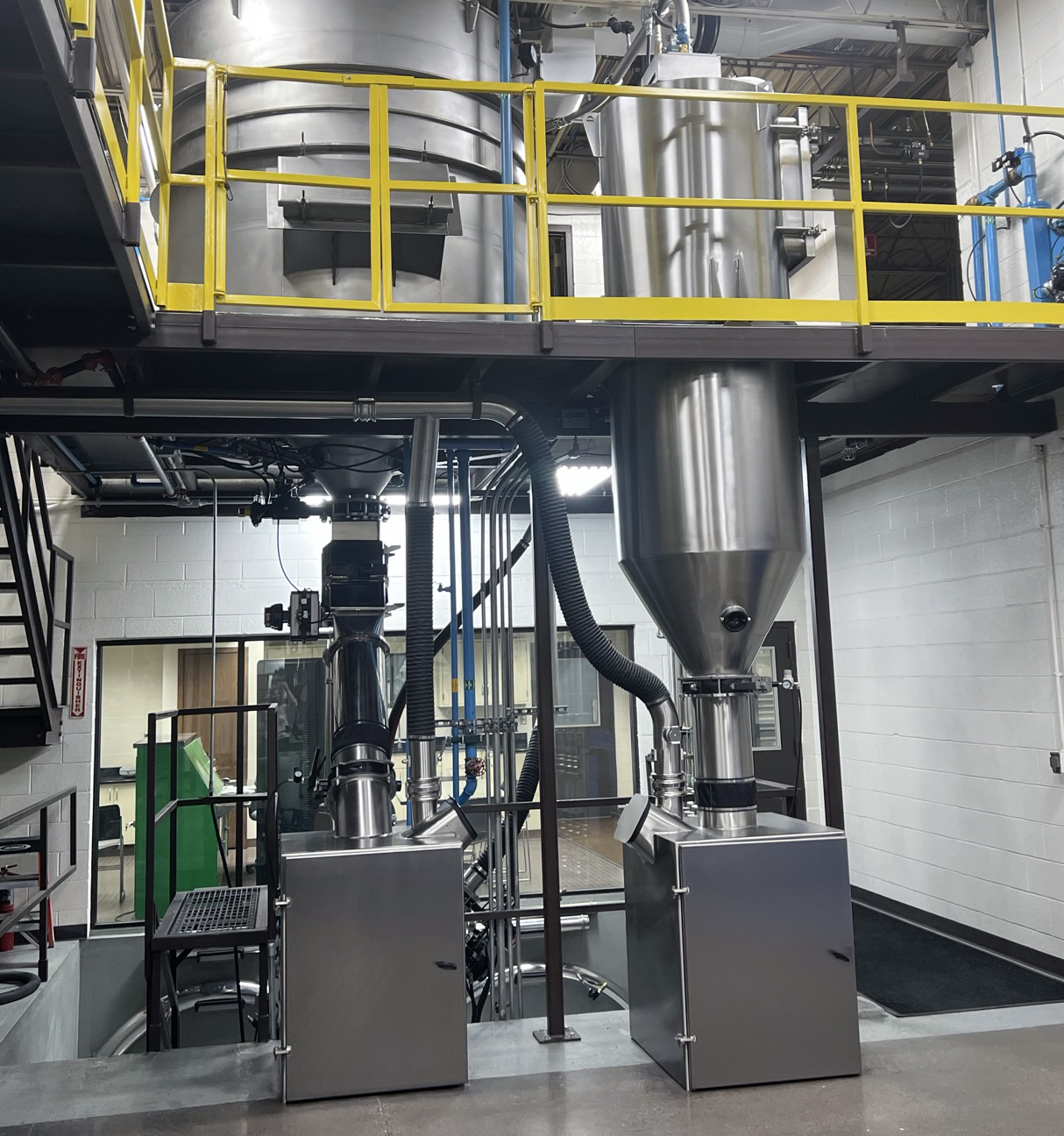
Our full-scale test facility is built to replicate actual conveying conditions across a range of materials and system configurations. This allows customers to know how their bulk material will perform in a pneumatic conveying system under conditions that closely mirror their production environment.
The first step in the design process is to understand the conveyed material.
Every project begins with understanding the material itself. Pneumatic conveying tests allow us to understand:
- The critical data that will be used in our software model to predict the system rate, air consumption, convey pressure, etc.
- What conditions are appropriate to keep particle degradation within accepted tolerances
- What measures must be taken to ensure a reliable flow
This foundational analysis helps determine how the material will behave while conveying, and what system approach is most appropriate.
What Does Testing Provide?
Testing provides peace of mind that the pneumatic conveying system design is based on the data collected for your specific material.
What to expect after testing:
- A design that is based on your specific material
- Updated air consumption based on the results of testing
- Material samples for evaluation when particle degradation is a concern
Testing provides customers with confidence that their pneumatic conveying system is designed specifically for their material and operating requirements and not based on generic assumptions.
The Value of Testing Before Installation
Investing in testing upfront can significantly reduce your team’s downstream costs and delays.
Key benefits of testing with Dynamic Air include:
- Reduced commissioning time
- Lower risk of material handling issues
- Improved system efficiency and throughput
For many applications, testing with Dynamic Air provides clarity that simply can’t be achieved through calculations alone.
Frequently Asked Questions About Testing Materials for Pneumatic Conveying
What types of materials can be tested at Dynamic Air’s facility?
At Dynamic Air, our team conducts thorough testing on a wide range of bulk solids and powders, including fine, cohesive, abrasive, and fragile materials. Testing is customized based on material behavior and project goals. Unfortunately, toxic, explosive, or otherwise dangerous materials cannot be tested.
Why is testing important instead of relying on calculations alone?
Simply stated, dry bulk materials, even with the same chemical name, often behave radically differently when their physical properties differ.
Can testing determine whether dense phase or dilute phase conveying is better?
Yes. Testing allows engineers to observe how a material responds under different conveying modes and determine which approach delivers optimal performance, efficiency, and material integrity.
Is material testing required for every pneumatic conveying project?
Not always, but it is highly recommended. It’s not uncommon for a plant to have tested their material in the past, only to discover years later that their material has changed due to process changes or raw material supplier changes. Testing costs a small amount of effort and reaps a big reward.
How does testing improve long-term system reliability?
By identifying potential issues early. Testing helps ensure that the final system is engineered for consistent performance over time.
How much material is required for pneumatic conveying testing?
In general, around 45 cubic feet of material is required to conduct basic testing. Dynamic Air’s application engineer assigned to coordinate your testing will confirm this value.
In what type of containers should we send materials in?
Drums or 50 lb. bags are ideal.
Better Testing Leads to Better Pneumatic Conveying Systems
At Dynamic Air, our testing facility plays a vital role in delivering pneumatic conveying solutions that work as intended. Through testing and comprehensive system validation, we help customers move forward with confidence.
If you’re planning to purchase a new conveying system or evaluating bulk material behavior, we’d love to hear from you.
Let’s Find the Right Solution for You
Contact usPartner with Dynamic Air, the industry leader in providing reliable, innovative solutions. Our team of experts is ready to understand your unique requirements and design customized solutions tailored to your specific needs, whether it’s pneumatic conveying, equipment manufacturing, or other material handling challenges. Experience the Dynamic Air difference and unlock the potential of seamless material flow, enhanced efficiency, and optimized productivity. Contact us today to discuss your project.