
What Is Pressure Differential in Pneumatic Conveying?
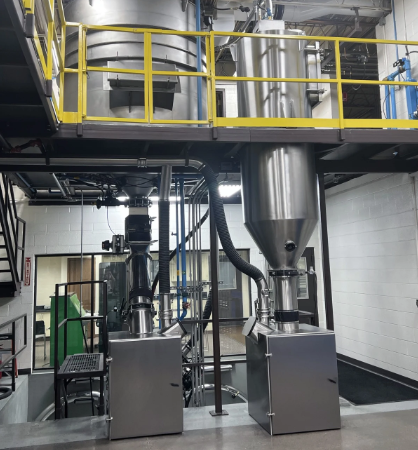
In pneumatic conveying systems, material doesn’t move by chance—it moves by design. At the center of that design is one critical principle: pressure differential.
Whether conveying fine powders, pellets, or granular bulk solids, pressure differential is the force that enables controlled, efficient transport through pipelines. It determines how fast materials move, how far they can travel, and how reliably a system performs over time.
This guide explains what pressure differential is, how it works in pneumatic conveying systems, and why it is essential to optimizing bulk material handling operations.
What Is Pressure Differential in Pneumatic Conveying Systems?
Pressure differential (ΔP) is the difference in air pressure between two points in a pneumatic conveying system.
In practical terms:
- Air flows from higher pressure to lower pressure
- This flow of air takes the bulk material along for the ride, moving the bulk material from point A to point B.
Without pressure differential, there is no airflow. And, like a sailboat on a dead-calm day without airflow, dry bulk materials cannot be conveyed.
Simple definition:
Pressure differential is the driving force behind pneumatic conveying systems.
How Does Pressure Differential Move Material in Pneumatic Conveying?
To understand how pressure differential moves material, it helps to look at the system as a controlled airflow environment.
Step-by-step process:
1. Air pressure is generated
A blower, fan, or compressor creates either positive pressure or a vacuum within the system.
2. A pressure imbalance is created
One section of the system has higher pressure, while another has lower pressure.
3. Bulk material is present between the high and low pressure
Bulk material enters the pipeline through a dense phase transporter, feeder, rotary valve, or similar device.
4. Air begins to flow (as does the material)
Air naturally moves from the high-pressure zone to the low-pressure zone, pushing or carrying the dry, bulk material.
The Role of Pressure Differential in Bulk Material Handling
Pressure differential is not just a theoretical concept—it directly impacts system performance, efficiency, and reliability in bulk material handling.
1. Drives Material Movement
Pressure differential creates the airflow needed to transport materials. Without sufficient pressure difference, materials will stall, settle, or plug the pipeline.
2. Affects Conveying Velocity
Air at higher pressure has more potential energy than air at lower pressure. This means that, when properly controlled, higher pressure differentials will result in lower velocities than low-pressure differential systems.
3. Impacts System Capacity
Due to the principle outlined above, a higher-pressure differential system can achieve a higher system rate in the same convey pipe size than a lower pressure differential system.
4. Affects Energy Efficiency
A higher pressure differential system typically has a lower power consumption than a lower pressure differential system. The reason for this is that a higher pressure differential has less “slip” of air through the bulk material due to a higher conveying density.
5. Velocity is the Key to Material Integrity or Pipe Wear
Particle degradation and pipe wear have one thing in common…they are both highly sensitive to conveying velocity. The lower the conveying velocity, the less particle degradation will occur when conveying fragile materials, and the less pipe wear will be observed when conveying abrasive materials. And it’s dramatic. Particle degradation and pipe wear are exponentially related to conveying velocity.
Controlling the conveying velocity is key to maintaining product quality when conveying fragile materials and improving reliability when conveying abrasive materials.
Types of Pneumatic Conveying Systems and How They Use Pressure Differential
Different system types rely on pressure differential in distinct ways. Understanding these differences is essential for selecting the right solution.
Dense Phase Conveying Systems
In dense phase systems:
- Compressed air pushes slugs of material through the pipe at a density close to the bulk density of the bulk material
- Typically conveys at a low convey velocity
- Pressure is highest at the material entry point and decreases along the convey pipe
Best suited for:
- Long-distance conveying
- High-capacity systems
- Fragile and abrasive materials
Dilute Phase Conveying Systems
In dilute phase systems:
- The bulk material is suspended in a high-velocity air stream
- The conveying density is much lower than the bulk density of the material
- Conveys at a high conveying velocity
- Pressure is lowest at the end of the system
Best suited for:
- Short-distance conveying
- Low-capacity systems
- Durable and non-abrasive materials
How Pressure Differential Is Measured in Pneumatic Conveying
Pressure differential is measured by comparing pressure readings at two points in the system.
Common units of measurement:
- PSI (pounds per square inch)
- Bar
- KPa
Monitoring methods:
- Pressure transducers
- Pressure gauges
Continuous monitoring allows the control system to:
- Detect system faults
- Prevent blockages
- Maintain optimal performance
Key Factors That Influence Pressure Differential
Several variables affect how the pressure differential behaves in a pneumatic conveying system:
1. System Design
The choice between dense phase and dilute phase conveying significantly impacts pressure requirements.
2. Pipeline Length and Configuration
Longer pipelines and complex routing (bends, vertical lifts) increase resistance, requiring greater pressure differential.
3. Material Characteristics
Properties such as:
- Bulk density
- Particle size
- Particle shape
- Moisture content
- Material cohesiveness
All influence how much pressure is needed to move the material.
4. Air Efficiency (Material to Air Ratio)
The power available to convey is related to the combination of air pressure and volume. The less air volume that is dedicated to conveying increases the required pressure to convey.
5. Pressure Differential Management
When the compressed air is introduced along the convey pipe through Air Saver devices, this improves the “leverage” of the air pressure by applying a pressure differential over a shorter distance (the distance between two adjacent air savers). This leveraged air management approach allows better control of conveying velocity (and particle degradation or abrasion), better conveying efficiencies, and resistance to convey pipe plugging.
Common Problems Caused by Improper Pressure Differential Management
When pressure differential is not properly managed, systems can experience a range of issues:
Material Plugging
Insufficient pressure differential results in system plugging.
Excessive Wear or Particle Degradation
Without proper pressure differential management, air volume must be increased to prevent plugging. And when conveying fragile or abrasive materials, these higher conveying velocities lead to particle degradation when conveying fragile materials or pipe wear when conveying abrasive materials.
Energy Inefficiency
When increased air volume is required instead of using leverage (Air Saver technology), this leads to inefficient conveying, which means using more air than necessary to move the material compared to a system with a properly managed pressure differential.
Best Practices for Optimizing Pressure Differential
To ensure efficient pneumatic conveying, pressure differential must be carefully managed, controlled, and optimized.
Choose a System with an Active Pressure Differential Management (Air Saver) Technology
A system that incorporates Air Savers to actively manage pressure differential is the single most important feature when particle degradation or pipe wear, conveying efficiency, and reliability are of prime concern. If a plugged system means the whole process stops, then this crucial detail must not be overlooked.
Design for the Material
Each material behaves differently. The system design should be tailored to its specific characteristics.
Monitor and Actively Control System Performance
The convey system should incorporate a modern control system with proven software, sensors, and automated instruments to track pressure levels, detect issues, and most importantly, automatically react and correct.
Minimize System Resistance
Efficient pipeline design reduces the pressure required to move material.
Choose the Right Conveying Mode
Dense phase or dilute phase should be selected based on material type and operational goals.
Optimize Your Pneumatic Conveying System with the Right Pressure Differential
Pressure differential is the foundation of pneumatic conveying systems. It determines how materials move, how efficiently systems operate, and how reliably they perform over time.
A well-designed system doesn’t simply maximize pressure; it optimizes it.
Understanding and controlling pressure differential is key to building a more efficient, reliable bulk material handling operation.
The experts at Dynamic Air can help you evaluate your current system, identify opportunities for optimization, and engineer a solution tailored to your specific material and application.
Contact us today to get started!
Let’s Find the Right Solution for You
Contact usPartner with Dynamic Air, the industry leader in providing reliable, innovative solutions. Our team of experts is ready to understand your unique requirements and design customized solutions tailored to your specific needs, whether it’s pneumatic conveying, equipment manufacturing, or other material handling challenges. Experience the Dynamic Air difference and unlock the potential of seamless material flow, enhanced efficiency, and optimized productivity. Contact us today to discuss your project.